


How to Check Quality of Agricultural Machinery Parts Before Importing (Buyer Checklist)
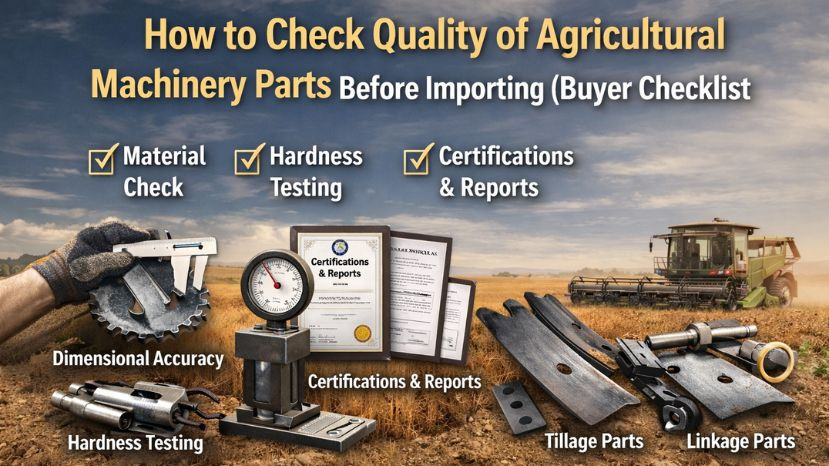
This checklist is designed for importers, dealers, and bulk buyers evaluating agricultural machinery parts.
Importing agricultural machinery parts involves more than comparing specifications or supplier catalogs. Buyers need to ensure that parts will perform consistently under real working conditions and match required standards across multiple shipments.
Since agricultural equipment operates in demanding environments, even small variations in material, hardness, or dimensions can affect performance over time. This makes it important to verify quality before placing bulk orders.
This guide outlines practical checks that can help buyers evaluate agricultural parts more clearly before importing.
What is agricultural machinery part quality?
Agricultural machinery part quality refers to the material strength, dimensional accuracy, hardness, and durability of components used in farming equipment to ensure consistent performance under real field conditions.
How do you check the quality of agricultural machinery parts before importing?
You can check quality by reviewing material specifications, verifying hardness and heat treatment, confirming dimensional accuracy, checking certifications, and requesting testing reports or samples from the supplier.
Why is quality verification important before importing agricultural parts?
Quality verification helps ensure that parts perform reliably during actual use and reduces the chances of early wear or operational issues.
In real field conditions, agricultural parts operate under continuous stress. Soil abrasion, load pressure, and vibration all affect performance. For example, in sandy or abrasive soil envi ronments, wear rates can increase if hardness is not properly balanced.
Dealers often face consistency issues when specifications vary between batches. Even small dimensional differences can affect fit and long-term usability.
In short: consistent quality supports stable performance across different operating conditions.
What should you check before importing agricultural machinery parts?
1. What material is used in the part?
Agricultural parts are commonly made from carbon steel, alloy steel, or boron steel, depending on the application.
Material selection has a direct impact on wear resistance and strength. For example, components such as tillage parts are exposed to continuous soil contact and require materials that can handle abrasion.
In bulk export orders, inconsistent material sourcing can result in variations in performance across batches.
2. How is hardness and heat treatment verified?
Hardness is typically measured in HRC and indicates resistance to wear and deformation.
In real usage:
Softer parts may wear faster
Over-hardened parts may become brittle under impact
Balanced heat treatment helps maintain both durability and flexibility. Buyers can request hardness ranges or basic reports from suppliers.
3. Does the part meet dimensional accuracy?
Dimensional accuracy ensures that parts fit correctly within machinery systems.
Precision processes like CNC machining help maintain consistency. In actual operations, even small misalignment can lead to vibration or uneven wear.
For replacement components such as Three Point linkage kit parts, matching required specifications is important for proper assembly.
4. Is there a proper surface finish or coating?
Surface coating helps protect parts from environmental exposure.
During storage or shipping, parts may be exposed to moisture. Coatings such as paint or powder coating help reduce corrosion risk and maintain usability before installation.
Uniform finishing also indicates better production consistency.
5. How strong is the welding or fabrication?
For fabricated parts, welding quality affects structural strength.
In field usage, stress often concentrates around joints. Weak welding can lead to cracks or early failure.
Visual consistency and finishing can provide basic indicators of fabrication quality.
6. Are certifications available?
Certifications indicate that the supplier follows defined manufacturing processes.
Standards like ISO are commonly used in export manufacturing. While certifications do not guarantee product performance, they can support consistency across production batches.
Depending on the destination country, compliance requirements such as BIS or CE standards may also apply to certain components.
7. Are testing and inspection reports provided?
Testing reports help validate specifications such as hardness and dimensions.
In export supply, documentation helps reduce confusion between buyer and supplier. For new sourcing relationships, requesting samples along with reports can provide additional clarity.
8. Is the packaging suitable for export?
Packaging helps maintain product condition during transit.
Parts may go through multiple handling stages before reaching the buyer. Proper packaging reduces the risk of physical damage and environmental exposure.
This is particularly relevant for international shipments.
How can you differentiate between high-quality and low-quality parts?
Factor | Higher Quality | Lower Quality | Operational Impact | Risk Level |
Material | Defined grade | Unspecified | Performance variation | Medium |
Hardness | Controlled range | Unbalanced | Wear or cracking | High |
Fit | Accurate | Variable | Assembly issues | Medium |
Finish | Uniform coating | Uneven | Corrosion risk | Medium |
These differences may not always be immediately visible but tend to appear during actual usage.
What manufacturing practices indicate reliable agricultural parts?
Consistent manufacturing processes generally indicate better reliability.
This includes:
Controlled raw material selection
Precision machining
Defined heat treatment
Final inspection
How do you verify an agricultural parts supplier before importing?
Supplier verification involves reviewing technical capability and communication clarity.
Buyers often:
Ask about production processes
Request product samples
Review documentation
Confirm specification matching
In export supply, long-term consistency is an important factor, not just initial quality.
Pre-Shipment Inspection (PSI): What Should Be Checked Before Dispatch?
Pre-shipment inspection is a process where parts are checked before being shipped to ensure they meet agreed specifications.
Common checks include:
Surface condition: Look for rust, uneven coating, or visible defects
Welding quality: Check for cracks or weak joints
Dimensional accuracy: Verify measurements using tools like calipers
Thread and bolt quality: Ensure proper fitting and strength
Material confirmation: Match actual material with specifications
In export supply, some buyers also use third-party inspection agencies to review goods before dispatch.
What should you check in critical components?
Different components may require specific checks:
Hydraulic parts: Check for leakage and sealing quality
Gears and transmission parts: Ensure smooth finish and proper hardening
Rubber components: Look for cracks or stiffness
Example scenario: why quality checks matter
A buyer sourced tillage parts without confirming hardness specifications.
During field use in abrasive soil conditions, the parts showed faster wear than expected. This led to frequent replacement and interruptions in operation.
This highlights the importance of verifying specifications before placing bulk orders.
What questions should you ask before placing an order?
What material specification is used?
What hardness range is maintained?
Are inspection or test reports available?
Can the parts match OEM specifications?
How is consistency maintained across batches?
Clear communication at this stage helps reduce uncertainty later.
How to avoid low-quality agricultural parts in bulk import?
Avoiding low-quality parts starts with verifying specifications and not relying only on general descriptions.
Buyers can:
Request samples before bulk orders
Confirm material and hardness details
Check consistency across batches
Taking these steps helps reduce variation and improve reliability in long-term supply.
Conclusion
Checking material, hardness, dimensional accuracy, and supplier consistency helps reduce uncertainty when importing agricultural machinery parts.
Clear specifications and consistent quality become especially important when scaling bulk imports across multiple shipments.
For bulk sourcing, working with experienced manufacturers who maintain consistent specifications, testing support, and export-ready processes can improve long-term reliability.
In export-oriented supply, companies like JCBL Agri typically focus on maintaining stable production standards and clear specifications across shipments.
FAQs
How do I check agricultural machinery part quality?
You can check quality by verifying material specifications, hardness (HRC), dimensional accuracy, surface finish, and requesting test reports or samples from the supplier.
What is the ideal hardness for tillage tools?
The ideal hardness depends on application, but it should be balanced to ensure both wear resistance and impact strength. Overly hard parts may crack, while softer parts may wear quickly.
How to verify an agricultural machinery parts supplier before importing?
You can verify a supplier by reviewing manufacturing capability, checking certifications, requesting samples, confirming technical specifications, and evaluating consistency across batches and previous export experience.
What are the most important quality factors in agricultural machinery parts?
Key factors include material grade, hardness level, dimensional accuracy, welding quality (if applicable), surface coating, and consistency in production across multiple batches.
How can I avoid low-quality agricultural parts in bulk import?
You can avoid low-quality parts by not relying only on price, requesting samples before bulk orders, verifying technical specifications, and ensuring clear communication with the supplier regarding quality standards.
What is pre-shipment inspection (PSI) in agricultural parts?
Pre-shipment inspection is a quality check conducted before dispatch to verify that parts meet agreed specifications.
How to avoid defects in imported machinery parts?
By verifying specifications, requesting samples, and conducting inspection before shipment.


Comments